
Recursion in Java Explained

- What Is Recursion in Java
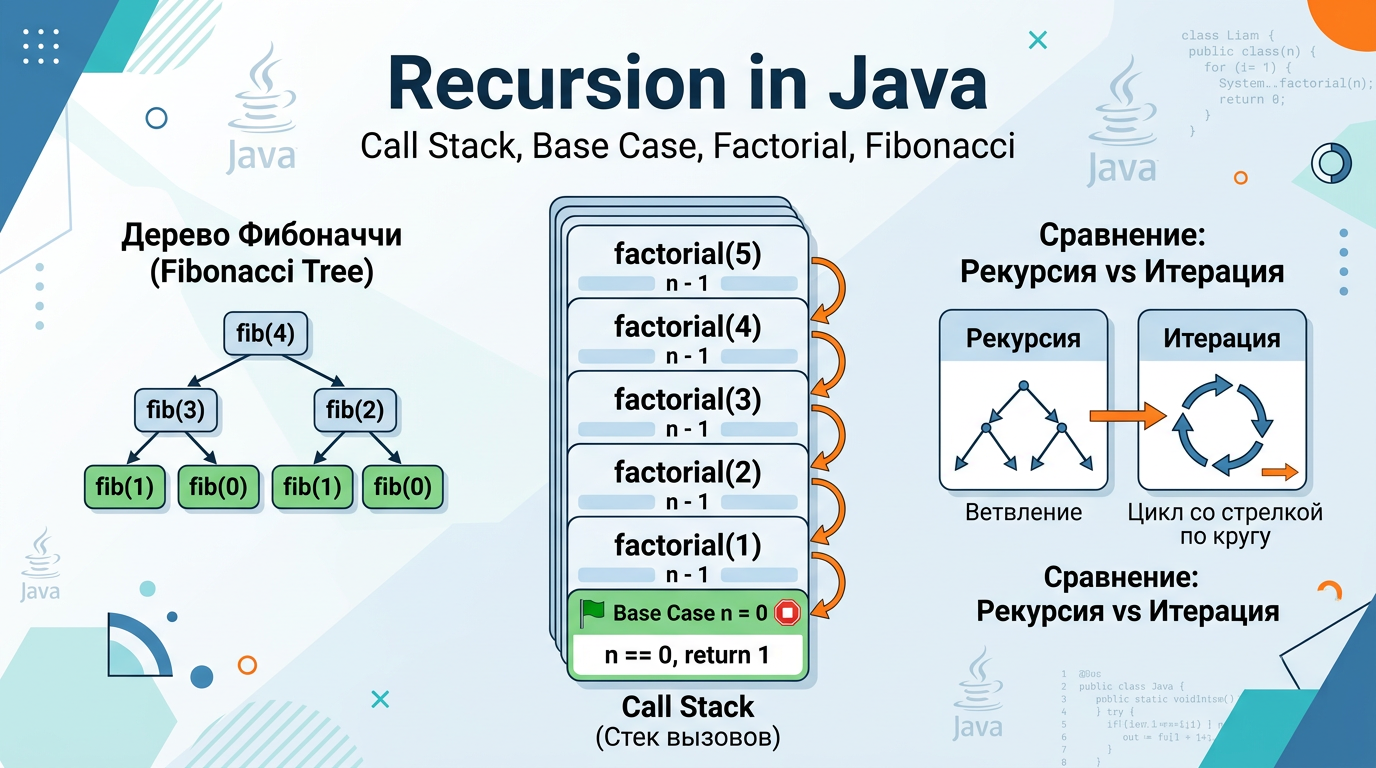
- How Recursion Works (Call Stack)
- Base Case and Recursive Call
- Example: Factorial Using Recursion
- Example: Fibonacci Numbers (Recursion)
- Recursion vs Iteration
- Common Recursion Mistakes
- Conclusion
Recursion in Java is a programming technique in which a method calls itself to solve a problem. Recursive solutions are especially useful when a task can be divided into smaller, similar subproblems.
1. What Is Recursion in Java
A recursive method is a method that calls itself directly or indirectly. Each such call is placed on the call stack.
Recursion is commonly used to solve the following types of problems:
- factorial calculation
- Fibonacci numbers
- tree and graph traversal
- “divide and conquer” algorithms
2. How Recursion Works (Call Stack)
Each time a recursive method is invoked, Java creates a new frame in the call stack. This frame stores:
- method parameters
- local variables
- return address
When a method finishes execution, its frame is removed from the stack, and control returns to the previous call.
3. Base Case and Recursive Call
Every recursive method must have a base case — a condition under which recursion stops.
If the base case is missing or implemented incorrectly, recursive calls will continue indefinitely, resulting in a StackOverflowError.
- Base case — terminates the recursion
- Recursive case — the method calls itself with modified arguments
4. Example: Factorial Using Recursion
The factorial of a number n is defined as follows:
n! = n × (n - 1) × (n - 2) × ... × 1
Recursive implementation in Java:
public class RecursionExample {

    static int factorial(int n) {
        if (n == 1) { // base case
            return 1;
        }
        return n * factorial(n - 1); // recursive call
    }

    public static void main(String[] args) {
        int result = factorial(5);
        System.out.println("Factorial of 5 = " + result);
    }
}
Here:
n == 1— base casefactorial(n - 1)— recursive call
5. Example: Fibonacci Numbers (Recursion)
The Fibonacci sequence is another classic example of recursion:
public class FibonacciExample {

    static int fibonacci(int n) {
        if (n <= 1) {
            return n;
        }
        return fibonacci(n - 1) + fibonacci(n - 2);
    }

    public static void main(String[] args) {
        System.out.println(fibonacci(6));
    }
}
Important: this example is useful for learning recursion, but it is inefficient for large values of n. In real-world projects, loops or memoization should be used instead.
6. Recursion vs Iteration
Many problems solved using recursion can also be implemented with loops. However, recursion often provides:
- cleaner and more readable code
- a natural solution for hierarchical data structures
Disadvantages of recursion:
- higher memory consumption due to the call stack
- risk of StackOverflowError
- lower performance compared to iteration
7. Common Recursion Mistakes
- missing base case
- recursive call that does not move toward the base case
- excessive recursion depth
Always ensure that each recursive call brings the program closer to termination.
8. Conclusion
Recursion in Java is a powerful technique that allows developers to solve complex problems elegantly. Understanding how recursion works, including the call stack and base case, is essential for every Java developer.
Please log in or register to have a possibility to add comment.